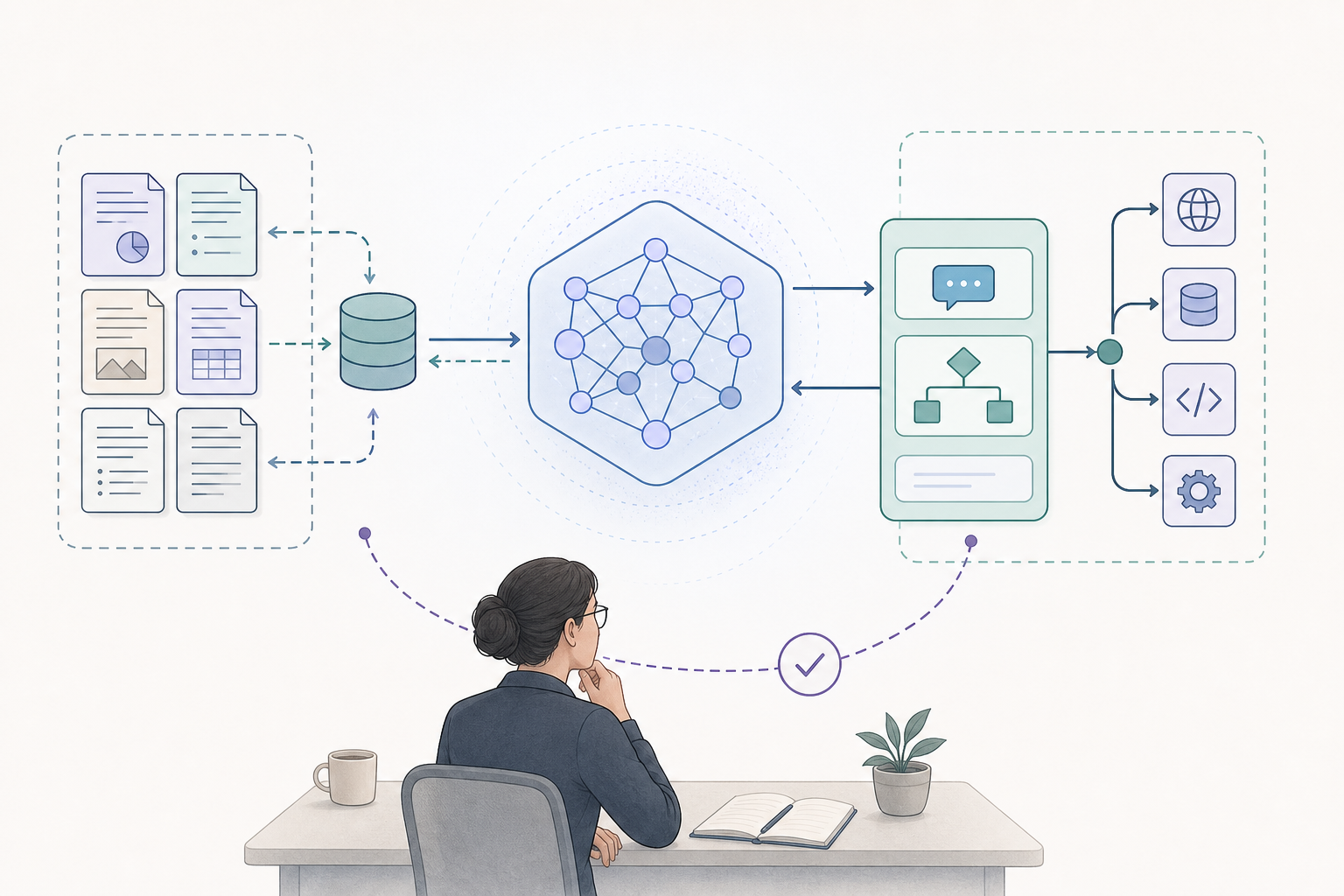
1. Introduction: Breaking the “Magic” Illusion
In modern tech circles and software engineering teams, Large Language Models (LLMs) are frequently treated as sentient “black boxes” or magical thinking entities capable of intuitive human reasoning. We type a natural language prompt into a sleek interface, and out comes remarkably coherent prose, complex system design, or production-ready code. This seamless experience often creates a persuasive illusion that artificial intelligence possesses actual understanding, logical intent, or digital consciousness.
The engineering reality beneath the user interface is far more mechanical, structured, and mathematical. Behind every streaming response, automated tool call, or autonomous agent loop lies an execution pipeline built on token probabilities, vector coordinates, standardized communication protocols, and state engines. Demystifying these systems requires peeling back the hype to inspect the architectural truths driving modern AI—moving step-by-step from foundational parameter weights and token generation to vector databases, protocol adapters, multi-agent orchestration, and production-grade AI engineering.
2. Stripped of Randomness, an LLM Is Just a Pure Mathematical Function
At its foundational level, a Large Language Model does not “think”—it computes. To understand how an LLM operates, it is helpful to place it within the broader taxonomy of modern artificial intelligence:
Artificial Intelligence → Machine Learning → Neural Networks → Deep Learning → LLMs
When developers talk about a model having “7 billion parameters,” they are not referring to a database of explicit facts or rules. Parameters are the tuned numerical weights—floating-point numbers distributed across the network’s layers—that were calculated during the training process on vast datasets. These weights can encode learned information.
When you strip away intentional stochasticity (randomness), a neural network can be viewed mathematically as a pure function: passing identical inputs into a fixed network under deterministic execution will yield the same numerical output.
[User Prompt] ➔ [Tokenization] ➔ [Numerical IDs] ➔ [Vector Embeddings] ➔ [Probability Distribution] ➔ [Next Token Output]
The Token Processing Pipeline
An LLM processes and generates text through a rigid, continuous pipeline:
- Tokenization: The input text is parsed into tokens, which serve as the minimal structural units of text. Depending on the language and tokenizer rules, a token can represent a subword, a punctuation mark, or a full word.
- Numerical Mapping: Each unique token is mapped to an integer index within the model’s vocabulary dictionary.
- Embedding Vector Mapping: These numerical indices are mapped to embeddings—high-dimensional vectors that capture semantic meaning on a multidimensional plane. On this mathematical coordinate plane, semantically close concepts (such as “car”, “auto”, “machine”, and “automobile”) sit close together, whereas unrelated concepts (such as “supermarket” or “phone”) are placed far apart.
- Next-Token Probability Distribution: The neural network processes these vector inputs through its weight layers to compute a probability distribution across its entire vocabulary for the single next token in the sequence. It selects a token based on this distribution, appends it to the sequence, and repeats the cycle in a loop until a stop sequence is encountered.
This is a simplified picture: tokens are tokenizer-defined units, not necessarily linguistic units. Token embeddings differ from retrieval embeddings, and the word-distance examples are not guaranteed relationships. Generation can also stop at a token limit. The probabilities below are illustrative.
                       [ High Probability ] ➔ "learning" (82%)
[ Input Context ] ➔  { Probability Engine } ➔ "roadmap"  (11%)
                       [ Low Probability  ] ➔ "banana"   (0.001%)
Grounding Determinism: Temperature and Seed
If an LLM operates as a deterministic mathematical function, why does querying a commercial model multiple times produce different answers? These variations can be introduced by tuning explicit sampling hyper-parameters:
- Temperature: A mathematical scalar that adjusts the shape of the output probability distribution. Setting the temperature to near-zero creates a steep, sharp probability peak, favoring—but not forcing—selection of the highest-probability token. Raising the temperature flattens the curve, giving lower-probability tokens a chance to be selected, introducing creative variety or “experimentation.”
- Seed: An integer that initializes the pseudo-random number generator used during token sampling. Pinning the seed value supports repeatability under fixed execution conditions, but does not guarantee identical output.
In practice, near-zero temperature does not guarantee greedy decoding, and neither setting guarantees identical hosted responses across hardware, runtime or model changes. OpenAI describes text generation as non-deterministic and notes that different model snapshots can produce different results.
As an illustrative example, not a recorded test: if you submit the prompt "What is IT Booster?" to a model 100 consecutive times with Temperature set to 0.0, you might receive a repeated response such as "A platform for step-by-step learning and tech interview preparation."
However, if you raise the Temperature to 0.8, the flattened probability curve can yield varied responses across identical runs—one iteration framing it as "A platform for structured IT roadmaps," another as "A technical mentorship community," and another as "An interactive career preparation engine." These descriptions are hypothetical outputs, not verified facts about IT Booster.
In short: if you exclude randomness and hold the model and execution conditions fixed, a neural network can be viewed mathematically as a pure function.
3. RAG Doesn’t “Teach” the AI Anything—It Just Gives It an Open-Book Cheat Sheet
A widespread misconception in enterprise software development is that Retrieval-Augmented Generation (RAG) retrains, fine-tunes, or modifies the underlying weights of an LLM when connecting it to internal documentation or enterprise databases.
In ordinary inference-time RAG, retrieval alters zero model weights. It acts as an automated search and retrieval wrapper that fetches relevant textual fragments from an external source and injects them directly into the context window of the user’s prompt prior to execution. RAG systems can nevertheless include separately trained or fine-tuned components, as in the foundational RAG paper.
[User Prompt] ➔ [Vector Search in DB] ➔ [Retrieve Matching Chunks] ➔ [Inject into Context Window] ➔ [LLM Generates Answer]
The Architectural Mechanics of RAG
To expose an LLM to private codebases, support docs, or internal databases without costly retraining, a common vector-based RAG pipeline executes a four-stage process:
- Chunking: Large source documents and code files are segmented into small, digestible text blocks called chunks.
- Vectorization & Storage: An embedding model converts each chunk into a high-dimensional vector representation. These vectors are indexed and stored inside a specialized vector database.
- Semantic Search: When a user submits a prompt, the prompt is vectorized. The database executes a mathematical cosine similarity or distance search to identify the document chunks whose vectors sit closest to the prompt vector in semantic space.
- Context Augmentation: The raw text from those matching chunks is prepended to the user’s original prompt as reference context, instructing the model to construct its answer using only the provided text.
RAG can also use lexical or hybrid search without a specialized vector database. Retrieved context and instructions do not guarantee a correct or compliant answer.
Context Window Limits and Context Clutter
A common question arises: Why not avoid vector search entirely and dump an entire company database into the context window?
First, the context window (the total token budget an LLM can parse at one time) is strictly bounded. Second, filling the context window with irrelevancies can degrade performance—a problem often called “context clutter.” When context is flooded with noisy or historical logs, the model may fail to prioritize critical signals, increasing error rates. Long-context research also finds that the position of relevant information can affect performance.
To prevent context clutter during extended interactions, modern AI architectures deploy context optimization routines:
- Sliding Window: Drops older context tokens sequentially once a threshold is reached, maintaining only the most recent conversation history.
- Summarization: Uses a fast model pass to condense historical messages (e.g., compressing 200,000 raw context tokens into a dense 1,500-token summary), preserving key facts while reclaiming token capacity.
The compression figures are illustrative; summarization can also lose key facts.
Attention and the Root Cause of Hallucinations
To understand why models hallucinate false facts with supreme confidence, one must understand how the Transformer architecture processes text. Transformers rely on an Attention Mechanism (Self-Attention) to calculate contextual relationships and relative importance between tokens in a prompt, with additional mechanisms supplying positional information.
For instance, the Attention mechanism can help track how a single negative modifier token like "not" fundamentally flips the context of a 50-word sentence.
"Which features are NOT included in the core JavaScript specification?"
                   ▲
                   │ (Attention Mechanism links 'NOT' to surrounding API keywords)
However, because the network generates tokens rather than formally verifying every claim, fluent output is no guarantee of factual truth. Hallucinations occur when mathematical token probabilities favor a linguistically fluent response that is factually incorrect. Ambiguous or contradictory context chunks can further increase this risk. Attention is an architectural mechanism, not a complete explanation of hallucinations or a guarantee of correct negation handling.
4. AI Tools Don’t “Act”—They Just Generate Structured Requests (Enter MCP)
When an AI system edits a file on your filesystem, executes a command in a terminal, or queries a remote database, the language model itself is not interacting with the operating system or network hardware. In this text-generation setting, LLMs generate outputs; they possess no independent system execution rights or network sockets.
[User Prompt] ➔ [LLM Evaluates] ➔ [LLM Outputs JSON Payload] ➔ [External Host Executes] ➔ [Output Returned to LLM Context]
Mechanics of Tool Calling
When an LLM is provided with tool declarations (descriptions of function names, inputs, and schemas), it evaluates the prompt to determine if an external action is required. If it requests tool execution, the model outputs a structured request payload—typically formatted in JSON, depending on the API—containing:
- The exact key matching the requested function name.
- The specific input parameter values mapped to that tool’s schema.
An external host application (such as an application runtime, CLI tool, or IDE extension) intercepts this JSON payload, validates arguments and permissions, executes the actual code or API request locally or over the network, and injects the resulting output back into the LLM’s context window using the API’s tool-result format. The JSON below is illustrative; actual tool-call formats vary.
{
  "tool_call": "fetch_weather_data",
  "parameters": {
    "location": "San Francisco, CA",
    "units": "metric"
  }
}
Model Context Protocol (MCP): The Universal AI Adapter
Historically, integrating an LLM or AI agent with external data sources and execution environments (e.g., GitHub, Notion, Google Calendar, Postgres) often required developers to hand-craft custom API integrations for every unique model runner and service pair.
                                ┌──► [ MCP Server: GitHub ] ────► [ GitHub API ]
                                │
[ Agent / Host Runtime ] ───────┼──► [ MCP Server: Notion ] ────► [ Notion API ]
  (Standardized MCP Client)     │
                                └──► [ MCP Server: Postgres ] ──► [ Local Database ]
To reduce this integration sprawl, the Model Context Protocol (MCP) provides an open standard adapter between AI application hosts and downstream service providers.
Instead of writing custom API code for every agent, service providers expose an MCP Server that advertises its tools, resources, and capabilities over a standardized protocol. An MCP-compliant client can connect to compatible servers and invoke supported operations, subject to configuration, authentication and authorization, simplifying tool access across complex developer ecosystems. The MCP architecture standardizes these connections; its tool specification recommends human ability to deny invocations.
5. The True “AI Magic” Happens in the Agent Loop and Orchestration, Not the Model
A single-prompt chat window quickly breaks down when tasked with complex software development tasks. Translating high-level requirements into production software can benefit from transitioning from simple text generation to autonomous AI Agents.
Anatomy of an AI Agent
An AI Agent can be understood as an architectural orchestration system with six core components:
Agent = LLM (Brain) + Tools + Context + State + Instructions + Agent Loop
- LLM (The Brain): The underlying language model providing reasoning and probabilistic generation.
- Tools: Declared external execution capabilities (terminal, file system I/O, browser drivers).
- Context: The active informational text history passed into the prompt window.
- State: The runtime execution metadata (e.g., current task step, active tool execution flags, error counts, environment variables).
- Instructions: System prompts defining the agent’s role, operational constraints, and objective boundary conditions.
- The Agent Loop (Think → Act → Check → Repeat): The programmatic loop that drives autonomy. The agent evaluates its objective (Think), generates a tool call (Act), inspects the execution payload returned by the host (Check), and repeats the process until the objective is accomplished.
The loop also needs stopping conditions for failure, cancellation and resource limits.
       ┌────────────────────────────────────────────────────────┐
       ▼                                                        │
┌──────────────┐     ┌──────────────┐     ┌──────────────┐      │
│    THINK     │ ──► │     ACT      │ ──► │    CHECK     │ ─────┘
│ (Evaluate)   │     │ (Tool Call)  │     │ (Verify Out) │ (Loop until done)
└──────────────┘     └──────────────┘     └──────────────┘
Decoupling State from Context
A critical architectural requirement in long-running agentic systems is explicitly decoupling State from Context.
- Context represents the raw prompt stream and message back-and-forth.
- State represents execution metadata—tracking step indices, active error state, feature flags, and environment configurations.
If state technical flags are allowed to pollute the context text window, the token context quickly bloats, increasing token costs and potentially reducing accuracy. Decoupling state allows agent runtimes to manage step control out-of-band while maintaining a lean, optimized prompt context. Task-relevant state must still be available to the model.
Agent Harnesses
To control agent loops safely, developers deploy execution wrappers known as Harnesses, as used in agentic tools such as Codex or Antigravity. A harness acts as the execution wrapper built around the LLM, managing state tracking, enforcing loop iteration limits, intercepting tool failures, and maintaining security boundaries.
Multi-Agent Orchestration & The Reviewer Pattern
Relying solely on a single agent to write, test, and audit its own code risks correlated errors. An agent that generates a code bug may evaluate its output using the same cluttered context window that contributed to the bug in the first place.
Some systems address this using Multi-Agent Orchestration:
[ User Request ]
       │
       ▼
[ Developer Agent ] ◄─────── (Feedback Loop) ───────┐
       │                                            │
       ▼                                            │
[ Reviewer Agent ] ─────────────────────────────────┘
(Clean Context Window)
       │
       ▼ (If Approved)
[ Architect Agent ] ➔ (Validates against acceptance criteria) ➔ [ Final Output ]
Under the Reviewer Pattern:
- Developer Agent: Receives task instructions, generates implementation code, and executes local tests.
- Reviewer Agent: Initialized with a completely clean context window (devoid of the developer agent’s internal reasoning clutter) and specialized code-audit instructions. It independently reviews the raw code output and submits structured defect feedback back into the loop.
- Architect Agent: A supervising agent that evaluates the final deliverable against overall system specs and project acceptance criteria before authorizing final delivery.
This is one possible arrangement, not a universal requirement or guarantee of better results. Anthropic describes a related evaluator-optimizer pattern and recommends adding complexity only when needed.
Model Routing and Efficiency Trade-Offs
A common mistake in multi-agent system design is routing every micro-task to top-tier, high-parameter models. Running basic file formatting, log parsing, or preliminary tool calls on heavy reasoning models inflates execution costs and latency.
Modern systems employ Model Routing:
                       ┌──► [ Small / Fast Model ] ──► Tool Routing, Syntax Formatting, Log Parsing
[ Incoming Request ] ──┤
                       └──► [ Heavy Reasoning Model ] ──► Architecture Specs, Complex Refactoring, Logic Audits
By offloading simple tool calling and text processing to lightweight, fast models while reserving top-tier reasoning models for spec generation, architecture, and complex reviews, teams can reduce token spend while improving system throughput. Anthropic’s routing guidance describes directing simpler requests to smaller, cost-efficient models and harder requests to more capable models.
6. “Vibe Coding” vs. AI Engineering—Why Human-in-the-Loop Is Non-Negotiable
The accessibility of agentic AI tools has split modern development into two distinct practices: informal Vibe Coding and disciplined AI Engineering.
Editorial note—manual rendering correction required before publication: The comparison table has empty header cells; its intended column labels appear in the first body row. Moving those labels into the header requires a table-structure change restricted by this workflow. The table is retained below for draft review only and must not be published until corrected.
| Comparison Criteria | Vibe Coding | AI Engineering |
| Focus / Primary Goal | Rapid execution speed, quick MVPs, throwaway scripts, and exploratory prototypes. | Production-grade software, enterprise maintainability, and architectural longevity. |
| Task Structure | Passing monolithic, un-decomposed prompts directly to an agent. | Granular task decomposition driven by Specification-Driven Development (SDD). |
| Code Review Method | AI writes and self-reviews; minimal to no manual human code inspection. | Human code review paired with automated multi-agent reviewer loops and test suites. |
| Target Applicability | Greenfield exploration, weekend hacks, and throwaway automation utilities. | Large existing codebases, mission-critical systems, and scalable enterprise applications. |
Specification-Driven Development (SDD)
The pillar of true AI Engineering is Specification-Driven Development (SDD). Instead of prompting an agent with vague instructions (e.g., "Build an authentication system"), SDD requires human engineers to author granular technical specifications, interface definitions, security requirements, and explicit acceptance criteria before passing execution tasks to builder agents.
[ Human Engineer ] ➔ Authors Granular Spec & Test Suite ➔ [ AI Agent ] ➔ Generates Code to Pass Spec
By constraining the agent with pre-defined specs and acceptance tests, SDD helps prevent agents from making wild architectural assumptions, introducing scope creep, or drifting from project design patterns.
Enforcing Standards via “Skills”
In structured AI engineering environments, reusable operational guidelines are modularized into Skills. Much like extracting reusable code into functions, a Skill is a packaged unit of instructions provided to an agent runtime. Skills guide adherence to team-wide coding standards, testing requirements, architectural choices, and security rules across continuous agent runs. Skills can include scripts and resources; tests and runtime controls, not instructions alone, provide enforcement.
The Non-Negotiable Role of the Human-in-the-Loop
Deploying unguided “vibe coding” inside established enterprise codebases can create fragile, unmaintainable architectures bloated with hidden bugs and technical debt. Language models do not reliably substitute for real-world engineering judgment—they can misinterpret prompts and take suboptimal structural shortcuts if unconstrained.
Maintaining a Human-in-the-Loop remains non-negotiable. Software engineering domain expertise is required to:
- Deconstruct complex business requirements into modular technical specifications.
- Design robust agent topologies and orchestrate multi-agent reviewer pipelines.
- Author and maintain reusable agent Skills and architectural constraints.
- Critically inspect generated code to prevent technical debt and security regressions.
Modern AI models do not replace software engineering judgment; they act as powerful force multipliers that amplify human architectural expertise.
7. Conclusion: The Real Skill of the AI Era
Mastering modern AI requires abandoning the illusion of the “magic black box.” Large Language Models are mathematical engines that transform text through high-dimensional vector spaces, token probability distributions, and attention mechanisms; practical generation is not necessarily deterministic.
The transformative capabilities seen in state-of-the-art developer tooling do not stem from digital consciousness, but from robust engineering systems built around these models—standardized protocol adapters like MCP, programmatic agent loops (Think → Act → Check → Repeat), clean multi-agent orchestration patterns, model routing pipelines, and modular Skill libraries.
As artificial intelligence continues to advance, the defining skill for developers and tech leaders lies not in delegating control blindly to probabilistic models, but in mastering the architectural mechanics required to direct, constrain, and engineer these systems safely.
Are you simply “vibe coding” your way into technical debt, or are you architecting engineered AI systems where humans hold the steering wheel?