
AI News This Week: The 7 Developments That Matter for Business and Technology Leaders
AI’s most consequential shift this week is not a single benchmark or chatbot feature. It is the continued conversion of models into systems that can operate: listening during a phone call, connecting to tools, running work in the background, and handling longer coding tasks. For leaders, that changes the central question from “Which model writes the best answer?” to “Which systems can complete useful work safely, predictably, and at an acceptable total cost?”
This briefing covers the most decision-relevant AI news and signals for July 5–12, 2026. The evidence is uneven. Two infrastructure and voice developments are dated within the week; other items provide context or appear only in secondary reporting and should not be treated as confirmed news without primary-source support. That distinction is essential for decision-makers.
AI news this week at a glance
The week’s central theme: AI is moving from answering questions to taking action
Google’s July 7 expansion of Managed Agents in the Gemini API added support for background tasks and remote Model Context Protocol (MCP) servers. It positions agent infrastructure—not simply model access—as a product category. Google’s announcement describes infrastructure for work that can persist beyond a single prompt and connect to external tools.
On July 9, an OpenAI developer-community post listed new realtime API models, gpt-realtime-2.1 and gpt-realtime-2.1-mini. The community announcement says they are intended for voice agents that can listen, reason, translate, transcribe, use tools, and take action while a conversation is underway. The important signal is that voice is increasingly being positioned as an interface for tool-using systems, rather than only a layer for transcription or spoken responses.
The seven developments covered and why they made the cut
- Google expanded Managed Agents in the Gemini API on July 7, adding background-task and remote-MCP support. This is a confirmed, week-specific infrastructure development. Source
- OpenAI’s realtime voice-model announcement appeared on July 9. It points toward conversational agents that can use tools during live interactions, although the available evidence is a developer-community announcement. Source
- Agentic coding is becoming more consequential. OpenAI says nearly one-quarter of Codex requests concern work that would take a person more than an hour—a useful adoption signal, not a week-specific product launch. Source
- Cloud investment is being directed toward agent scale. Google says it is helping organizations build and manage thousands of agents, relevant context for the Managed Agents expansion. Source
- Voice-AI economics remain an enterprise gate. A case study reports substantial call-handling savings, but it is a vendor-reported result, not an independent market benchmark. Source
- The EU AI Act’s August 2 date is approaching. General applicability is listed as beginning on August 2, 2026, while general-purpose AI model provisions began applying on August 2, 2025. Source
- Startup-financing reports require restraint. Several funding claims circulated in a secondary roundup, but the available research does not include company or investor confirmation. They belong on a watch list, not in a confirmed funding ledger. Source
Frontier AI models are competing on voice, reasoning, cost, and execution
OpenAI’s realtime models and the move toward voice agents
The research pack does not substantiate a product called “GPT-Live.” It does support a July 9 listing for two new realtime API models, gpt-realtime-2.1 and gpt-realtime-2.1-mini. According to the announcement, their intended use is voice agents that can “listen, reason, translate, transcribe, use tools, and take action while the conversation is still unfolding.”
The business implication is straightforward: evaluate voice systems as workflow interfaces, not merely as speech-to-text add-ons. A customer-service agent that understands an utterance is useful. One that can retrieve approved context, invoke an authorized tool, and complete a bounded request may affect service design, escalation procedures, and staffing assumptions.
What leaders should watch next: evidence of reliability during interruptions, handoffs, tool failures, and ambiguous requests. Live interaction increases the value of low latency, but it also leaves less time for policy checks and human intervention.
New and emerging models: compare capability claims, availability, and evidence
Model news should be separated into confirmed availability, vendor capability claims, and evidence from production deployment. Google previously described Gemini 3.5 Flash as “our first in a series of models combining frontier intelligence with action.” Google’s 2026 I/O announcement also positioned the model around agentic capabilities. That is useful context, but the material provided does not establish it as a new July 5–12 release.
The more consequential week-specific signal is the infrastructure surrounding models. Google says Managed Agents lets developers “build and deploy managed agents on the Gemini API,” “define agents as files,” and “run them in secure cloud sandboxes.” Google’s Managed Agents description suggests that the model is becoming one component of a broader managed execution environment.
What model competition means for enterprise buyers and model portfolios
Enterprise buyers should not frame selection as a permanent single-model decision. Voice interaction, coding, document work, tool use, latency, and cost impose different requirements. A portfolio approach can assign a model or service to a bounded workload while maintaining common controls for identity, auditability, data access, and evaluation.
The practical comparison is based on completed, permitted outcomes. For a voice agent, measure whether it reaches the correct disposition and escalates appropriately. For a coding agent, test whether output passes the organization’s review and deployment controls. Capability demonstrations inform evaluation; they do not replace it.
Enterprise AI is shifting from copilots to organization-wide agents
The infrastructure connecting agents to business tools and workflows
Google’s July 7 update matters because it explicitly connects managed agents with background work and remote MCP servers. Google’s announcement places agents closer to the tools, services, and tasks where operational work occurs.
MCP support is relevant as an integration pattern because an agent is only as useful as the context and actions it can safely access. In business terms, the agent layer needs controlled connections to systems of record and operational tools—not broad, unmonitored access.
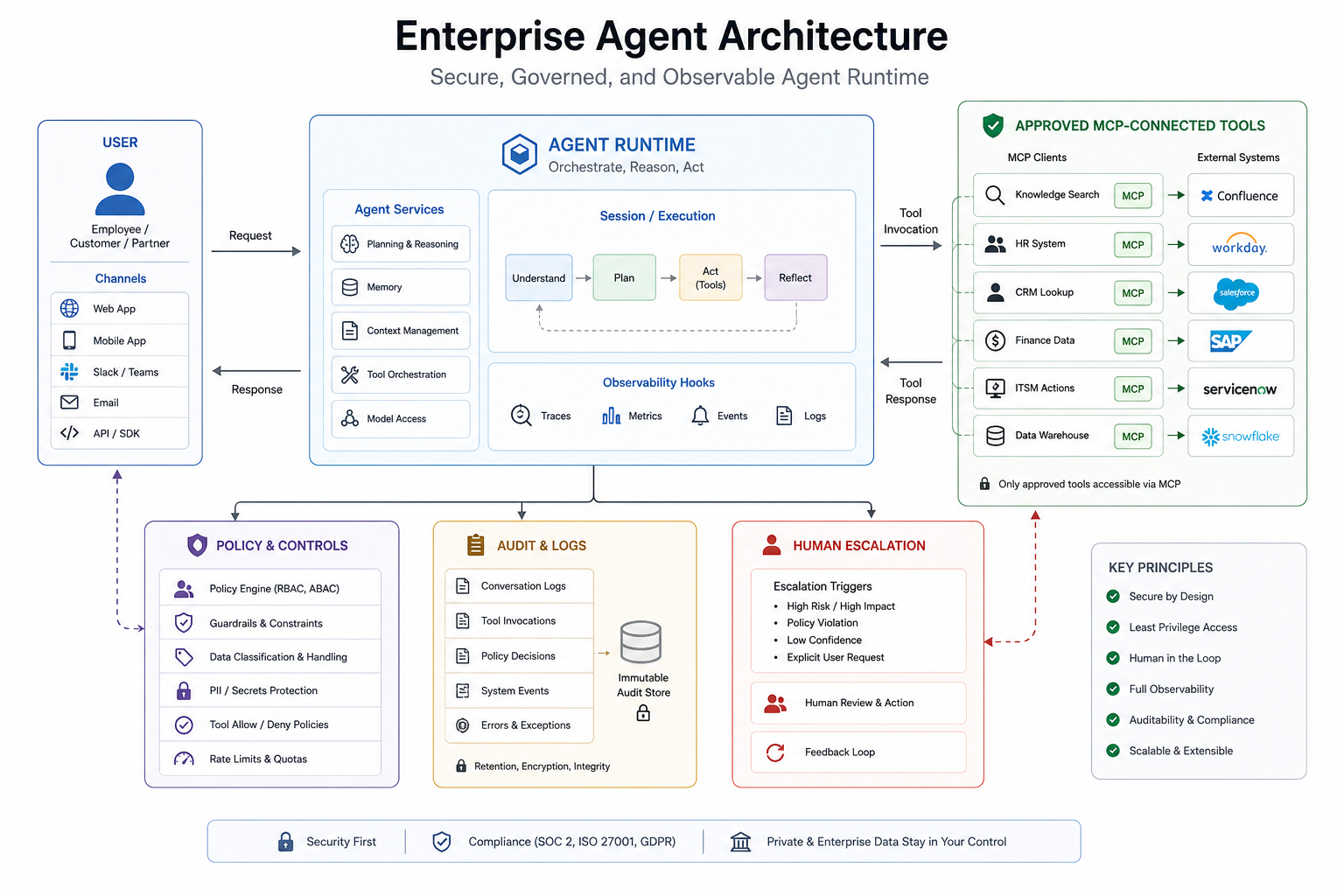
Why data quality, permissions, observability, and human oversight are now bottlenecks
As agents gain tool access, implementation risk shifts from answer quality alone to authorization and execution. Leaders should define which data an agent may read, which actions it may propose, which it may execute, and where a human must approve or take over. Where the workflow permits, an agent’s permissions should be narrower than those of the employee or service account it represents.
Observability is equally important. Teams need records connecting a result to its inputs, tool calls, approvals, and exceptions. Without that chain, a successful demonstration can become an operational blind spot.
Practical implication: evaluate agents by completed business outcomes, not demo quality
OpenAI reports that “nearly a quarter of all Codex requests are for tasks that would take a person more than one hour to complete.” OpenAI’s analysis signals that users are assigning agents longer-horizon work. It does not, by itself, establish quality, cost savings, or safe autonomy.
For each pilot, define a business outcome and an operating boundary. Examples include an approved code change, a correctly routed support case, or a completed research packet meeting a review standard. Track completion, exception rate, required human effort, and the consequences of errors. That scorecard is more useful than an impressive conversational demo.
AI economics: focus on total deployment cost
Model routing, speculative decoding, caching, and smaller models
The available research does not provide a new July 5–12 pricing announcement or benchmark for model routing, speculative decoding, caching, or smaller models. Leaders should treat broad claims about falling inference costs as planning hypotheses requiring vendor-specific validation, not as confirmed results from this week.
A portfolio architecture can still match a task’s quality, latency, and action risk to an appropriate model or service. The objective is not simply to use the least expensive model. It is to minimize total cost per accepted business outcome, including retries, reviews, integration work, and error remediation.
Why lower operating costs could expand AI deployment beyond pilot projects
An OpenAI customer case study says teams using Retell AI reported “up to 80% reductions in call handling costs.” The case study is not an independent benchmark, and the result should not be generalized to every contact-center deployment. It does illustrate why voice automation economics are attracting attention: useful work at a lower operating cost can move deployment decisions beyond experimentation.
The costs leaders still need to budget for: integration, governance, security, and supervision
Model usage is only one budget line. Agent deployment also requires workflow integration, access controls, testing, monitoring, incident handling, and human supervision. For sensitive or regulated processes, documentation and review capacity may matter more than marginal model cost. A procurement case should separate model spend from the cost of making an agent dependable in production.
AI regulation and policy: the rules executives should monitor
Developments affecting the EU AI Act and other major AI governance regimes
The immediate verified timeline signal is that the EU AI Act’s general applicability is listed as beginning on August 2, 2026; provisions concerning general-purpose AI models began applying on August 2, 2025. Timeline source
A separate June 29 secondary report says an EU Digital Omnibus package delayed the deadline for stand-alone Annex III high-risk systems to December 2, 2027, and shifted the date for high-risk systems embedded in regulated products to August 2, 2028. That report requires confirmation from an official EU Council or Commission source before executives use those dates for compliance planning.
What regulation means for high-risk systems, documentation, transparency, and procurement
Even the secondary report says the cited extensions do not substantively remove requirements concerning risk management, technical documentation, human oversight, and post-market monitoring. Source The practical message for buyers is that a revised deadline, if confirmed, would change sequencing rather than eliminate the need to build governance evidence.
Three questions compliance and product teams should ask this week
- Which deployed or planned systems could be classified as high risk, and what evidence supports that assessment?
- Can the organization reconstruct the system’s inputs, approvals, tool actions, and human overrides?
- Have legal and procurement teams verified current dates against official sources rather than relying on secondary summaries?
AI startup funding: unverified reports centered on infrastructure and specialized agents
The week’s notable funding, valuation, acquisition, or partnership developments
A secondary roundup reported that Norm Ai raised $120 million at a $1.2 billion valuation, ARC Intelligence raised €4 million to build an AI layer connecting ERP systems, and geoSurge raised $12 million to help brands manage representation in generative AI. The roundup is not primary-source confirmation. These figures should remain unverified until the companies or investors publish supporting announcements.
Why the reported themes matter
The reported themes—compliance, ERP connectivity, and generative-AI representation—point toward value propositions beyond a general-purpose chat interface. However, the research pack does not establish an industry-wide investor preference or funding trend. Leaders should distinguish a plausible pattern in unverified reports from a verified market conclusion.
How enterprise buyers should assess startup durability and vendor risk
Ask whether a supplier can operate with your identity systems, permissions model, data-retention requirements, audit process, and fallback workflows. Also test portability: if an underlying model changes, can the workflow continue with another provider? The more central an agent is to a business process, the more important contractual continuity and exit planning become.
Generative AI beyond text: voice, video, robotics, and multimodal systems
The most substantive generative AI capability developments this week
Voice is the clearest confirmed multimodal development in this briefing. The July 9 realtime-model announcement describes systems intended to combine conversation with reasoning, translation, transcription, tool use, and action. Source The research pack provides no comparable confirmed July 5–12 announcement for video or robotics.
From digital generation to physical-world action
“Action” should not be used loosely. In this week’s verified announcements, it refers to actions mediated through software tools and connected services, including those accessible through agent infrastructure. Physical-world deployment brings separate safety, reliability, and operational requirements not evidenced in the available materials.
Separate meaningful technical progress from marketing claims
A useful filter is whether an announcement identifies the operating environment, controls, and work the system can perform. Google’s discussion of secure cloud sandboxes, background tasks, and remote MCP support is more operationally specific than a generic claim of intelligence. Source Specificity still does not replace independent testing.
What this week’s AI developments mean for enterprise strategy
Reassess the model strategy: single vendor, multi-model, or routed portfolio
Use separate evaluation tracks for interactive voice, coding, retrieval, and tool-using agents. A single vendor may simplify governance, while a routed portfolio may better fit varied requirements. The decision should follow measured outcomes, data constraints, and operational resilience—not an assumption that one model is best at every task.
Prioritize workflows where agents can act within controlled boundaries
Start with workflows that have clear inputs, permitted actions, review points, and recoverable failure modes. Managed execution and connected tools can create value, but they also turn model errors into operational events. Initial production use cases should make that risk manageable by design.
Add regulatory, security, and cost controls before scaling
Scale governance with capability. Before expanding agent permissions or user reach, establish access boundaries, audit trails, approval paths, and workload-specific evaluation. The EU timeline makes this especially urgent for organizations with European exposure, even as reported deadline changes await official confirmation. Source
Bottom line: five AI signals to watch next week
Model capability versus model economics
- Whether new voice and agent systems publish evidence beyond capability descriptions.
- Whether enterprises disclose total workflow economics rather than isolated model-price claims.
Agent reliability and enterprise adoption
- Whether background agents and remote tool connections come with stronger controls for permissions, monitoring, and recovery.
- Whether longer-horizon agent use translates into verified completion quality, not simply more ambitious requests.
Regulation, infrastructure investment, and startup consolidation
- Whether official EU sources confirm reported high-risk-system deadline changes.
- Whether the week’s startup funding reports receive primary-source confirmation—and whether vendors can demonstrate durable integration and governance capabilities.
Next step: use this week’s announcements to audit one candidate agent workflow. Identify the business outcome, the tools it needs, the least privilege it requires, the human approval point, and the evidence needed to prove it worked. That exercise will reveal more about AI readiness than another chatbot pilot.